Jesus' First Full Year of Ministry

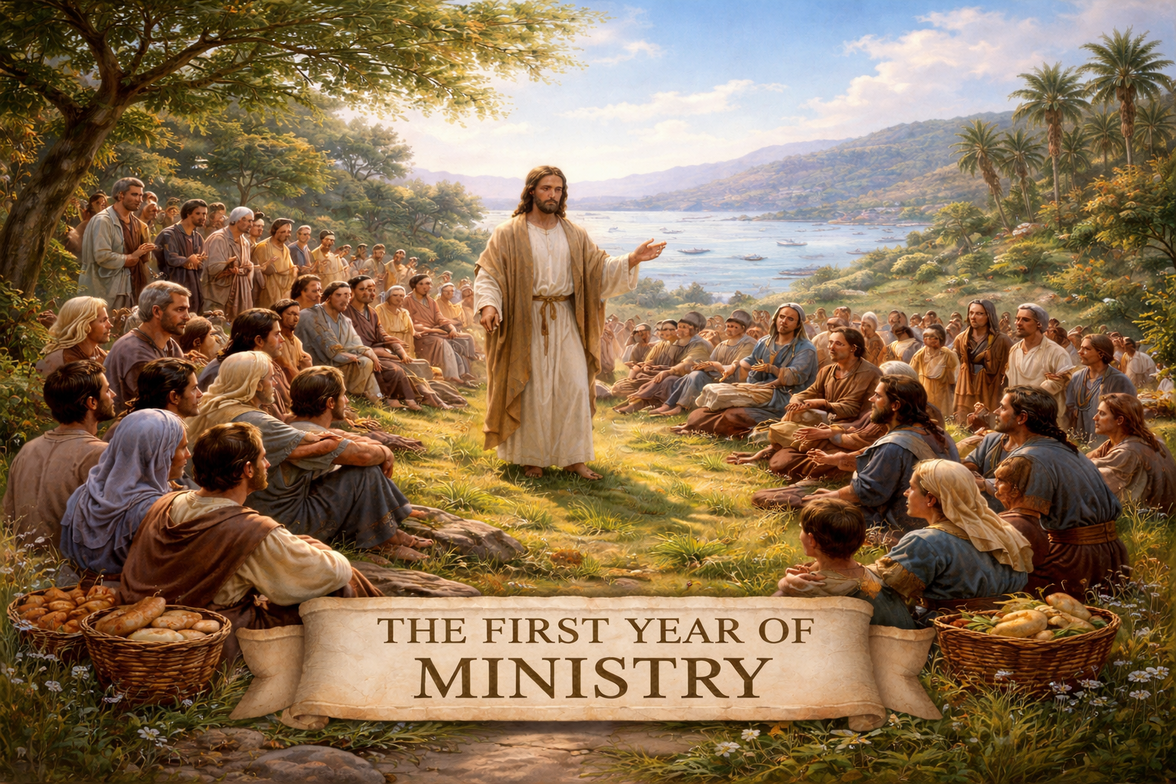
When Did Jesus Start His Ministry?
It will probably come as no surprise that scholars have different opinions as to what year Jesus started His ministry. One calculation references the first Passover during Jesus’ ministry, when the Jews said that the temple had stood for 46 years (John 2:20). Since Herod is said to have started the reconstruction and expansion in 20 B.C. (Maxwell quoting Josephus), 46 years would date Jesus’ first Passover to be in A.D. 27. However, if the reconstruction refers to the completion of the temple edifice, 18/17 B.C., then 46 years brings us to a date of A.D. 29/30 for Jesus’ first Passover in ministry (Hoehner, p. 42-43).
The consensus of scholars seems to agree that the date of Jesus’ first Passover was in A.D. 27, and therefore the beginning of His ministry (baptism by John the Baptist) was in the previous summer of A.D. 26., between the feasts of Pentecost (May) and Tabernacles (September or October). Therefore, the first events of Jesus’ ministry – His baptism, temptation in the wilderness, calling His first disciples, and His turning water into wine at the wedding in Cana – would have likely taken place during the summer or fall of A.D. 26.
The First Passover of Jesus’ Ministry – April A.D. 27
Arriving at Jerusalem for the first Passover since His public ministry began, Jesus cleared the temple of those who sold animals for sacrifices as well as money changers (John 2:14-22). That event, and other signs that Jesus did, caused many to believe in Him (John 2:23-25). While Jesus was in Jerusalem around that time is when He talked with Nicodemus and told Nicodemus that he must be born again (John 3:1-21).
For a time after Passover, Jesus’ disciples and John the Baptist’s disciples were both baptizing followers in the region of Judea, north of Jerusalem (John 3:22-24). During that time, John the Baptist testified that Jesus’ ministry would continue to grow (John 3:25-36).
John the Baptist is Thrown into Prison, Jesus Leaves for Galilee
John the Baptist boldly rebuked Herod Antipas for marrying Herodias, the wife of Herod’s brother. When Herod Antipas responded by throwing John the Baptist into prison (Matthew 14:3-5), Jesus departed and travelled north to minister in the region of Galilee (Matthew 4:12). While Galilee was His ultimate destination, Jesus stopped briefly in the town of Sychar in Samaria to talk with the woman at the well (John 4:4-30) around December A.D. 27 or January A.D. 28. Due to the positive response of the Samaritans, Jesus stayed a couple of days (John 4:39-42).
Jesus’ Ministry around Galilee
Jesus continued to the region of Galilee and was welcomed (John 4:43-45). Jesus then returned to the village of Cana (where He had turned water into wine) and healed the son of a nobleman (John 4:46-54). Teaching in the synagogues around Galilee (Luke 4:14-15), Jesus eventually spoke in the synagogue of His hometown of Nazareth (Luke 4:16). When Jesus spoke at Nazareth, He proclaimed that His ministry fulfilled the prophecy in Isaiah 61:1-2a. The crowd reacted so strongly to His claims that they tried to throw Him off a cliff (Luke 4:17-30).
Jesus in Capernaum
Jesus moved to the town of Capernaum, at the north end of the Sea of Galilee (Matthew 4:13-17), which fulfilled a prophecy from Isaiah 9:1-2. Soon after, Jesus called 4 fishermen – Peter, Andrew, James, and John – to become His disciples (Matthew 4:18-22, Mark 1:16-20).
Still in Capernaum, Jesus cast out a demon from a man in the synagogue (Luke 4:31-37, Mark 1:21-28). Afterward, Jesus went to Peter’s house and healed Peter’s mother-in-law (Luke 4:38-39, Mark 1:29-31), and that evening, all in that town that came to Him, He healed and cast out demons as needed (Luke 4:40-41, Mark 1:32-34).
Jesus Resumes Tour of Galilee, then Returns to Capernaum
Jesus continued His ministry in Galilee, preaching in synagogues and casting out demons (Luke 4:42-44, Mark 1:35-39). Once, when Jesus healed a leper, He instructed the man to show himself to a priest and tell no one else. However, the man proclaimed his healing widely, causing Jesus to remain in the wilderness rather than entering cities (Mark 1:40-45, Luke 5:12-16).
Returning to Capernaum, Jesus healed a paralyzed man whose friends lowered him down through a ceiling opening to be in front of Jesus. Not only did Jesus heal the man, but Jesus also forgave the man his sins (Mark 2:1-11, Luke 5:17-26) sparking controversy among the Pharisees.
Jesus called Matthew, a tax collector, to be one of His disciples. At a party afterward – possibly celebrating Matthew’s new career – Jesus compared Himself to a physician (Matthew 9:9-13, Mark 2:13-17, Luke 5:27-31). Then Jesus was questioned about why His disciples did not fast. Jesus replied that such fasting would happen once He was gone, and then He compared Himself to a bridegroom and compared His ministry to new wine (Matthew 9:14-17, Luke 5:33-39).
Sources
Maxwell, J., Historical Jesus, 2024, pgs. 16-24.
MacArthur, J., The MacArthur Study Bible, 2nd Ed., 1997, pgs. 1241-1242.
Hoehner, H., Chronological Aspects of the Life of Christ, 1973, pgs. 60-61.